Wednesday, February 27, 2019

Top Biotech Stocks To Invest In Right Now

tags:AMGN,BIIB,ARQL,ALNY, What happened

Shares of ProQR Therapeutics N.V. (NASDAQ:PRQR) were up 16% as of 3:48 p.m. EDT on Monday. ProQR didn't report any new announcements, but the biotech's update last Wednesday from a phase 1/2 clinical study -- of RNA medicine QR-110, in treating Leber congenital amaurosis type 10 (LCA10) -- still had investors fired up.

In its announcement last week, ProQR stated that patients receiving QR-110 experienced clinically meaningful responses in both visual acuity and ability to navigate a mobility course after three months of treatment. The experimental drug also appeared to be tolerated relatively well by patients, with no serious adverse events reported.

Image source: Getty Images.

So what

ProQR Therapeutics' phase 1/2 results justify the stock's big jump, in my view. LCA10 is the leading cause of genetic childhood blindness, with around 2,000 individuals known to have the disease. Currently, there are no approved treatments for LCA10 and no other drug in clinical development other than QR-110.

Top Biotech Stocks To Invest In Right Now: Amgen Inc.(AMGN)

Advisors' Opinion:
  • [By Logan Wallace]

    Amgen (NASDAQ:AMGN) was upgraded by stock analysts at BidaskClub from a “hold” rating to a “buy” rating in a research note issued on Monday.

  • [By Jon C. Ogg]

    In September of 2016, Amgen Inc. (NASDAQ: AMGN) announced that the FDA had approved its Amjevita as a biosimilar to Humira for multiple inflammatory diseases that included RA and several other related inflammatory diseases.

  • [By Stephan Byrd]

    PNC Financial Services Group Inc. trimmed its stake in Amgen, Inc. (NASDAQ:AMGN) by 0.3% during the second quarter, according to its most recent disclosure with the SEC. The fund owned 2,120,853 shares of the medical research company’s stock after selling 6,484 shares during the quarter. PNC Financial Services Group Inc.’s holdings in Amgen were worth $391,489,000 as of its most recent SEC filing.

  • [By Trey Thoelcke]

    Amgen Inc. (NASDAQ: AMGN) shares saw a nice bump after the U.S. Food and Drug Administration (FDA) on Thursday approved Aimovig (erenumab), Amgen’s preventive treatment of migraine in adults. It is the first FDA-approved preventive migraine treatment in a new class of drugs, which work by blocking the activity of calcitonin gene-related peptide, which is believed to play a critical role in migraine attacks.

  • [By Keith Speights]

    Gilead Sciences (NASDAQ:GILD), Amgen (NASDAQ:AMGN), and Johnson & Johnson (NYSE:JNJ) rank as the three top biopharmaceutical companies when it comes to cash stockpiles. Here's what these drugmakers are most likely to do with all that money -- and whether or not you should consider investing some of your hard-earned cash to buy their stocks.

  • [By Stephan Byrd]

    Cpwm LLC increased its holdings in Amgen, Inc. (NASDAQ:AMGN) by 59.7% in the 2nd quarter, according to its most recent disclosure with the Securities & Exchange Commission. The institutional investor owned 8,702 shares of the medical research company’s stock after purchasing an additional 3,253 shares during the period. Cpwm LLC’s holdings in Amgen were worth $1,606,000 at the end of the most recent quarter.

Top Biotech Stocks To Invest In Right Now: Biogen Idec Inc(BIIB)

Advisors' Opinion:
  • [By Chris Lange]

    Short interest in Biogen Inc. (NASDAQ: BIIB) decreased to 2.85 million shares from the previous 3.59 million. The stock recently traded at $316.87, within a 52-week range of $249.17 to $388.67.

  • [By Keith Speights]

    Investors haven't been happy with either Biogen (NASDAQ:BIIB) or Celgene (NASDAQ:CELG) lately. But the level of discontent is much higher with Celgene. The biotech stock has dropped more than 20% so far in 2018, compared to a single-digit percentage decline for Biogen.

  • [By Logan Wallace]

    Biogen (NASDAQ:BIIB) last released its quarterly earnings data on Tuesday, April 24th. The biotechnology company reported $6.05 earnings per share for the quarter, topping the consensus estimate of $5.93 by $0.12. The firm had revenue of $3.13 billion for the quarter, compared to analyst estimates of $3.15 billion. Biogen had a net margin of 23.54% and a return on equity of 37.64%. Biogen’s quarterly revenue was up 11.4% on a year-over-year basis. During the same quarter in the prior year, the business earned $5.20 earnings per share. research analysts anticipate that Biogen will post 23.94 earnings per share for the current year.

Top Biotech Stocks To Invest In Right Now: ArQule Inc.(ARQL)

Advisors' Opinion:
  • [By Logan Wallace]

    ValuEngine downgraded shares of ArQule (NASDAQ:ARQL) from a strong-buy rating to a buy rating in a research report sent to investors on Saturday.

    Several other brokerages also recently issued reports on ARQL. Zacks Investment Research upgraded shares of ArQule from a hold rating to a buy rating and set a $2.75 target price for the company in a research note on Tuesday, May 8th. B. Riley set a $4.00 target price on shares of ArQule and gave the company a buy rating in a research note on Monday, March 26th. Roth Capital raised their target price on shares of ArQule from $5.00 to $6.00 and gave the company a buy rating in a research note on Tuesday, April 17th. BidaskClub upgraded shares of ArQule from a hold rating to a buy rating in a research note on Saturday, May 19th. Finally, Leerink Swann upgraded shares of ArQule from a market perform rating to an outperform rating in a research note on Thursday, April 5th. One research analyst has rated the stock with a sell rating, six have issued a buy rating and one has issued a strong buy rating to the company. The company has an average rating of Buy and a consensus price target of $5.35.

  • [By Maxx Chatsko]

    Shares of development-stage biopharma ArQule (NASDAQ:ARQL) rose nearly 17% today after the company announced two appointments to its management team in two newly created positions. Dr. Marc Schegerin will serve as senior vice president, corporate strategy, communication, and finance. Dr. Shirish Hirani will serve as senior vice president, program management and product planning. 

  • [By Lisa Levin] Gainers Melinta Therapeutics, Inc. (NASDAQ: MLNT) shares surged 20.6 percent to $6.39. WBB Securities upgraded Melinta Therapeutics from Hold to Speculative Buy. Shoe Carnival, Inc. (NASDAQ: SCVL) shares climbed 17.2 percent to $30.87 after the company reported upbeat quarterly earnings. Acorn International, Inc. (NYSE: ATV) shares rose 15.2 percent to $28.804 after the company declared a special one-time cash dividend of $14.97 per ADS. Foot Locker, Inc. (NYSE: FL) gained 15 percent to $53.35 after the company reported better-than-expected results for its first quarter. Sears Hometown and Outlet Stores, Inc. (NASDAQ: SHOS) surged 14.2 percent to $2.625. ArQule, Inc. (NASDAQ: ARQL) rose 13 percent to $5.12 after gaining 4.86 percent on Thursday. Quality Systems, Inc. (NASDAQ: QSII) gained 12.8 percent to $16.97 after the company posted better-than-expected FQ4 results. Loma Negra Compañía Industrial Argentina Sociedad Anónima (NYSE: LOMA) shares rose 12 percent to $12.94. ArQule, Inc. (NASDAQ: ARQL) shares rose 12 percent to $5.07. Mirati Therapeutics, Inc. (NASDAQ: MRTX) climbed 11.4 percent to $43.50. Zai Lab Limited (NASDAQ: ZLAB) gained 11.3 percent to $24.7000. Zymeworks Inc. (NASDAQ: ZYME) rose 9.7 percent to $19.64. Park City Group, Inc. (NASDAQ: PCYG) climbed 9 percent to $7.90. Roku, Inc. (NASDAQ: ROKU) gained 7.9 percent to $38.82 after Citron reversed previously bearish position on the stock. Sears Holdings Corporation (NASDAQ: SHLD) shares jumped 7.3 percent to $3.55. Deckers Outdoor Corp (NYSE: DECK) rose 3.5 percent to $107.27 after reporting better-than-expected results for its fiscal fourth quarter.

    Check out these big penny stock gainers and losers

  • [By Ethan Ryder]

    ArQule, Inc. (NASDAQ:ARQL) insider Value Fund L. P. Biotechnology sold 1,035,939 shares of the business’s stock in a transaction dated Wednesday, May 30th. The shares were sold at an average price of $5.00, for a total value of $5,179,695.00. The transaction was disclosed in a filing with the SEC, which is available through this hyperlink.

  • [By Joseph Griffin]

    ValuEngine upgraded shares of ArQule (NASDAQ:ARQL) from a buy rating to a strong-buy rating in a research report released on Tuesday.

    Several other equities analysts have also issued reports on ARQL. Zacks Investment Research upgraded ArQule from a hold rating to a buy rating and set a $2.50 price objective for the company in a research report on Tuesday, March 20th. BidaskClub upgraded ArQule from a buy rating to a strong-buy rating in a research report on Saturday, March 24th. B. Riley set a $4.00 price objective on ArQule and gave the company a buy rating in a research report on Monday, March 26th. Leerink Swann upgraded ArQule from a market perform rating to an outperform rating in a research report on Thursday, April 5th. Finally, Roth Capital boosted their price objective on ArQule from $5.00 to $6.00 and gave the company a buy rating in a research report on Tuesday, April 17th. One equities research analyst has rated the stock with a sell rating, five have assigned a buy rating and two have issued a strong buy rating to the stock. The company has a consensus rating of Buy and a consensus target price of $5.35.

  • [By Stephan Byrd]

    Get a free copy of the Zacks research report on ArQule (ARQL)

    For more information about research offerings from Zacks Investment Research, visit Zacks.com

Top Biotech Stocks To Invest In Right Now: Alnylam Pharmaceuticals Inc.(ALNY)

Advisors' Opinion:
  • [By Brian Orelli]

    Alnylam Pharmaceuticals (NASDAQ:ALNY) and Ionis Pharmaceuticals (NASDAQ:IONS) looked to be in a two-horse race to develop TTR amyloidosis (ATTR) drugs. Alnylam recently got its drug Onpattro approved, while Ionis Pharmaceuticals and its marketing partner Akcea Therapeutics (NASDAQ:AKCA) should hear about Tegsedi by Oct. 6. Tegsedi was approved in the EU last month.

  • [By Sean Williams, Chuck Saletta, and Brian Feroldi]

    So, which biotech stocks should you consider buying in June? That's a question we posed to three of our healthcare-focused investors. Interestingly enough, mid-cap biotech stocks are the clear flavor of the month. If biotech is on your radar in June, our investors suggest you consider Ionis Pharmaceuticals (NASDAQ:IONS), Spark Therapeutics (NASDAQ:ONCE), and Alnylam Pharmaceuticals (NASDAQ:ALNY).

  • [By Shane Hupp]

    Alnylam Pharmaceuticals (NASDAQ:ALNY) was downgraded by analysts at Zacks Investment Research from a hold rating to a sell rating. According to Zacks, “Although we are pleased with Alnylam’s broad and promising pipeline, we note that most candidates are in their early or mid stages of development. These candidates still have a long way to go before hitting the market. Currently, Alnylam depends heavily on Onpattro for growth. We also note that gaining approval for pipeline candidates has become more difficult now.  However,  In August, Alnylam got a significant boost with the approval of Onpattro (patisiran), a first-of-its-kind RNA interference (RNAi) therapeutic, both in the United States and in Europe, for the treatment of the polyneuropathy of hereditary transthyretin-mediated (hATTR) amyloidosis in adults. This is the first approved candidate for the company and hence should drive revenues. Loss estimates have remained stable ahead of the Q3 earnings release.”

  • [By Cory Renauer]

    Taking a medical breakthrough from concept through commercial success is like ascending a mountain that grows taller and more treacherous with every setback. It's taken Alnylam Pharmaceuticals, Inc. (NASDAQ:ALNY) 16 years to launch its first drug, so challenges have had plenty of time to take up positions along this company's path to a successful first launch.

  • [By Keith Speights]

    It's not exactly David vs. Goliath. However, Bellicum Pharmaceuticals (NASDAQ:BLCM) and Alnylam Pharmaceuticals (NASDAQ:ALNY) are definitely in different leagues right now. Both are clinical-stage biotechs, but Bellicum's market cap is less than $350 million while Alnylam's market cap is close to $10 billion.

Wednesday, February 20, 2019

Best Dividend Stocks For 2019

tags:ATAX,RL,MMM,UNS,APH, &l;p&g;&l;img class=&q;dam-image shutterstock size-large wp-image-696513877&q; src=&q;https://specials-images.forbesimg.com/dam/imageserve/696513877/960x0.jpg?fit=scale&q; data-height=&q;640&q; data-width=&q;960&q;&g; Shutterstock

Here&a;rsquo;s the truth about the whole &a;ldquo;sell in May and go away&a;rdquo; strategy&a;mdash;following it will cost you huge gains and income. And if whipsawing markets have you thinking of cutting back on stocks this summer, you need to reverse course now.

Consider this: in the 9 years since the financial crisis, this &a;ldquo;advice&a;rdquo; only worked 3 times. And by &a;ldquo;worked,&a;rdquo; I mean you would have sidestepped a decline in the S&a;amp;P 500 by sitting out from May through October. Those are crap-shoot odds!

&l;b&g;Selling Low and Buying High&l;/b&g;

And the wins you would have passed up are enough to make any investor weep.

Take last year: say you were holding &l;b&g;Valero Energy,&l;/b&g; one of the 5 &a;ldquo;surprise&a;rdquo; dividend growers I&a;rsquo;ll say more about below (4 of which are primed to drop big payout hikes on us in the next 6 months).

Best Dividend Stocks For 2019: America First Tax Exempt Investors L.P.(ATAX)

Advisors' Opinion:
  • [By Shane Hupp]

    America First Multifamily Investors LP (NASDAQ:ATAX) Director Lisa Y. Roskens bought 5,965 shares of the stock in a transaction that occurred on Monday, August 27th. The shares were purchased at an average price of $5.95 per share, for a total transaction of $35,491.75. Following the purchase, the director now owns 100,069 shares in the company, valued at approximately $595,410.55. The acquisition was disclosed in a filing with the Securities & Exchange Commission, which can be accessed through this link.

  • [By Joseph Griffin]

    Bank of Montreal Can bought a new position in shares of America First Multifamily Investors LP (NASDAQ:ATAX) during the 2nd quarter, according to its most recent Form 13F filing with the SEC. The institutional investor bought 22,500 shares of the financial services provider’s stock, valued at approximately $143,000.

  • [By Stephan Byrd]

    TheStreet downgraded shares of America First Multifamily Investors (NASDAQ:ATAX) from a b- rating to a c+ rating in a research report released on Friday.

  • [By Stephan Byrd]

    BidaskClub upgraded shares of America First Multifamily Investors (NASDAQ:ATAX) from a strong sell rating to a sell rating in a research report sent to investors on Thursday morning.

Best Dividend Stocks For 2019: Polo Ralph Lauren Corporation(RL)

Advisors' Opinion:
  • [By Motley Fool Transcribers]

    Ralph Lauren Corp  (NYSE:RL)Q3 2019 Earnings Conference CallFeb. 05, 2019, 9:00 a.m. ET

    Contents: Prepared Remarks Questions and Answers Call Participants Prepared Remarks:

    Operator

  • [By Ethan Ryder]

    Ralph Lauren Corp (NYSE:RL) has been assigned an average recommendation of “Hold” from the twenty-three brokerages that are currently covering the firm, MarketBeat reports. Four equities research analysts have rated the stock with a sell rating, ten have assigned a hold rating, seven have issued a buy rating and one has assigned a strong buy rating to the company. The average 12 month target price among analysts that have issued a report on the stock in the last year is $106.94.

  • [By Lisa Levin] Companies Reporting Before The Bell Target Corporation (NYSE: TGT) is estimated to report quarterly earnings at $1.38 per share on revenue of $16.50 billion. Ralph Lauren Corporation (NYSE: RL) is expected to report quarterly earnings at $0.83 per share on revenue of $1.48 billion. Lowe's Companies, Inc. (NYSE: LOW) is projected to report quarterly earnings at $1.25 per share on revenue of $17.63 billion. Tiffany & Co. (NYSE: TIF) is estimated to report quarterly earnings at $0.83 per share on revenue of $957.49 million. Canadian Imperial Bank of Commerce (NYSE: CM) is expected to report quarterly earnings at $2.23 per share on revenue of $3.40 billion. Citi Trends, Inc. (NASDAQ: CTRN) is projected to report quarterly earnings at $0.9 per share on revenue of $210.70 million. Qiwi plc (NASDAQ: QIWI) is expected to report quarterly earnings at $0.25 per share on revenue of $60.19 million. iClick Interactive Asia Group Limited (NASDAQ: ICLK) is projected to report quarterly loss at $0.06 per share on revenue of $34.87 million.


  • [By Leo Sun]

    Several apparel retailers recently disproved the bears, who believed that sluggish mall traffic, e-tailers, and fast fashion players would bury older clothing stores. That list of winners includes Abercrombie & Fitch (NYSE:ANF), Guess (NYSE:GES), and Ralph Lauren (NYSE:RL), which rallied 81%, 116%, and 106%, respectively, over the past 12 months.

  • [By Jon C. Ogg]

    Ralph Lauren Corp. (NYSE: RL) was up 14% at $133.33 on Wednesday after earnings. Credit Suisse maintained its Outperform rating and raised its target to $153 from $135. Barclays left its Underweight rating in place but still raised its target to $110 from $103 after the stronger report.

  • [By Garrett Baldwin]

    Click here to learn more…

    Stocks to Watch Today: DIS, TMUS, BP, S Shares of Walt Disney Co. (NYSE: DIS) will lead a busy day of earnings reports. Wall Street is expecting a small decline in revenue for the first quarter. Disney is still in the process of absorbing most of Fox's assets from a deal last June. In addition, Disney will be launching its streaming service, Disney+, and investors will be looking for updates on the project. In deal news, T-Mobile U.S. Inc. (NYSE: TMUS) is looking to sweeten an offer to regulators to ensure a merger with rival Sprint Corp. (NYSE: S). The telecom giant told the U.S. Federal Communications Commission that it would freeze the prices of many plans if it receives approval for a deal. T-Mobile has offered $26 billion to buy Sprint. Shares of BP Plc. (NYSE: BP) rallied more than 3.7% after the global energy giant topped 2018 earnings expectations. The firm's big bets on shale developments have paid off. Profitability more than doubled over the previous year, while production topped out at 3.7 million barrels per day. Look for earnings reports from Allstate Corp. (NYSE: ALL), Anadarko Petroleum Corp. (NYSE: APC), Archer Daniels Midland Co. (NYSE: ADM), Becton, Dickenson & Co. (NYSE: BDX), BP Plc. (NYSE: BP), Chubb Ltd. (NYSE: CB), Digital Realty Trust (NYSE: DLR), Emerson Electric Co. (NYSE: EMR), Estee Lauder Co. Inc. (NYSE: EL), Lazard Ltd. (NYSE: LAZ), Pitney Bowes Inc. (NYSE: PBI), Plains All American Pipeline LP (NYSE: PAA), Ralph Lauren Corp. (NYSE: RL), Snap Inc. (NYSE: SNAP), and Tableau Software Inc. (NASDAQ: DATA).

    Follow Money Morning on Facebook, Twitter, and LinkedIn.

Best Dividend Stocks For 2019: 3M Company(MMM)

Advisors' Opinion:
  • [By Travis Hoium]

    Shares of 3M Co (NYSE:MMM) plummeted after the company reported first-quarter earnings this week because of a small reduction in full-year earnings guidance. 3M management still expects the company to grow organically at a rate of 3% to 4% this year, and it expects earnings per share (after pulling out one-time items such as a legal settlement) to be $10.20 to $10.55, which is up 11% to 15% from a year ago. But that wasn't enough for investors. 

  • [By Logan Wallace]

    Wilkins Investment Counsel Inc. lowered its holdings in shares of 3M (NYSE:MMM) by 6.0% during the first quarter, according to its most recent filing with the Securities and Exchange Commission. The institutional investor owned 45,045 shares of the conglomerate’s stock after selling 2,883 shares during the quarter. 3M comprises about 3.1% of Wilkins Investment Counsel Inc.’s investment portfolio, making the stock its 9th biggest position. Wilkins Investment Counsel Inc.’s holdings in 3M were worth $9,888,000 at the end of the most recent quarter.

  • [By Ethan Ryder]

    MMM has been the subject of several research reports. Zacks Investment Research raised shares of 3M from a “sell” rating to a “hold” rating in a research note on Monday, October 29th. Barclays decreased their price target on shares of 3M from $201.00 to $195.00 and set an “underweight” rating for the company in a research note on Wednesday, October 24th. Citigroup decreased their price target on shares of 3M from $251.00 to $228.00 and set a “buy” rating for the company in a research note on Wednesday, October 24th. Credit Suisse Group decreased their price target on shares of 3M from $228.00 to $222.00 and set an “outperform” rating for the company in a research note on Wednesday, October 24th. Finally, Royal Bank of Canada reaffirmed a “buy” rating and set a $213.00 price target on shares of 3M in a research note on Wednesday, December 19th. Three equities research analysts have rated the stock with a sell rating, eight have assigned a hold rating, five have issued a buy rating and one has given a strong buy rating to the company. The company currently has an average rating of “Hold” and a consensus price target of $214.57.

    WARNING: “Ippocratis Vrohidis Sells 8,153 Shares of 3M Co (MMM) Stock” was published by Ticker Report and is the property of of Ticker Report. If you are reading this piece on another site, it was stolen and republished in violation of United States & international trademark & copyright legislation. The correct version of this piece can be accessed at https://www.tickerreport.com/banking-finance/4147420/ippocratis-vrohidis-sells-8153-shares-of-3m-co-mmm-stock.html.

    About 3M

Best Dividend Stocks For 2019: UniSource Energy Corporation(UNS)

Advisors' Opinion:
  • [By Ethan Ryder]

    Uni Select (TSE:UNS) had its price target lifted by investment analysts at Macquarie from C$24.00 to C$25.00 in a report released on Wednesday. Macquarie’s price objective suggests a potential upside of 18.32% from the stock’s current price.

  • [By Max Byerly]

    Uni Select (TSE:UNS)‘s stock had its “hold” rating restated by equities research analysts at TD Securities in a report issued on Friday. They currently have a C$24.00 price objective on the stock. TD Securities’ price target points to a potential upside of 8.21% from the stock’s current price.

Best Dividend Stocks For 2019: Amphenol Corporation(APH)

Advisors' Opinion:
  • [By Logan Wallace]

    Get a free copy of the Zacks research report on Amphenol (APH)

    For more information about research offerings from Zacks Investment Research, visit Zacks.com

  • [By Ethan Ryder]

    Greenleaf Trust reduced its holdings in Amphenol (NYSE:APH) by 4.0% during the 1st quarter, according to its most recent disclosure with the Securities and Exchange Commission (SEC). The firm owned 17,234 shares of the electronics maker’s stock after selling 714 shares during the period. Greenleaf Trust’s holdings in Amphenol were worth $1,484,000 as of its most recent SEC filing.

  • [By Lee Jackson]

    This top stock has remained a favorite long-term pick at Deutsche Bank for some time. Amphenol Corp. (NYSE: APH) is one of the world's largest designers, manufacturers and marketers of electrical, electronic and fiber optic connectors, interconnect systems, antennas, sensors and sensor-based products and coaxial and high-speed specialty cable.

  • [By Ethan Ryder]

    Robeco Institutional Asset Management B.V. increased its holdings in shares of Amphenol (NYSE:APH) by 4.5% during the 1st quarter, according to the company in its most recent filing with the Securities and Exchange Commission (SEC). The firm owned 1,105,805 shares of the electronics maker’s stock after buying an additional 47,719 shares during the period. Robeco Institutional Asset Management B.V.’s holdings in Amphenol were worth $95,258,000 at the end of the most recent quarter.

  • [By Joseph Griffin]

    Get a free copy of the Zacks research report on Amphenol (APH)

    For more information about research offerings from Zacks Investment Research, visit Zacks.com

Tuesday, February 19, 2019

Top 5 Cheap Stocks To Invest In 2019

tags:USG,GD,EMR,SIRI,WEN,

Summer vacations have never been cheap. Americans, as a whole, spent $100 billion on summer vacations in 2017, according to a report released by Allianz Global Assistance. While older generations are likely to spend more money on travel, even thrifty millenials spend on average $1,373 on summer travel. With this being the case, rising gasoline prices could influence summer travel plans starting this Memorial Day weekend.

This year, 41.5 million Americans plan to travel over the Memorial Day Weekend, according to the AAA. Nearly 37 million plan to drive to their destination. Currently, the average gas prices hover near $3 per gallon, and this could have an impact on how consumers plan to spend their vacation time.

Whether or not these high prices will affect the number of people who travel this summer is yet to be seen. GasBuddy predicted in their Annual Summer Travel Survey that the high prices will negatively impact travel, and that 24% fewer people will travel during summer 2018 than in 2017. Those who do travel may choose to stay closer to home and have shorter vacations than in previous years.

Top 5 Cheap Stocks To Invest In 2019: USG Corporation(USG)

Advisors' Opinion:
  • [By Max Byerly]

    Get a free copy of the Zacks research report on USG (USG)

    For more information about research offerings from Zacks Investment Research, visit Zacks.com

  • [By Ethan Ryder]

    Get a free copy of the Zacks research report on USG (USG)

    For more information about research offerings from Zacks Investment Research, visit Zacks.com

  • [By Jason Hall, George Budwell, and Chuck Saletta]

    And while it may not always work out well to simply copy the moves other investors make, it can pay off to use their buying and selling moves as jumping-off points in your own research. We asked three real-world investors for their insight, and they wrote about two recent Buffett buys of Apple Inc. (NASDAQ:AAPL) and USG Corporation (NYSE:USG), and a recent Baker Brothers buy of Heron Therapeutics Inc (NASDAQ:HRTX). 

Top 5 Cheap Stocks To Invest In 2019: S&P GSCI(GD)

Advisors' Opinion:
  • [By Joseph Griffin]

    General Dynamics Co. (NYSE:GD) insider S. Daniel Johnson sold 77,810 shares of the stock in a transaction on Friday, September 14th. The shares were sold at an average price of $199.85, for a total value of $15,550,328.50. Following the completion of the transaction, the insider now owns 99,333 shares of the company’s stock, valued at approximately $19,851,700.05. The transaction was disclosed in a document filed with the SEC, which can be accessed through the SEC website.

  • [By Lou Whiteman]

    Sciple: That will be our first look at how any of these companies was affected by the shutdown. We had a lot of defense contractors reporting earnings in this past week. Lockheed Martin (NYSE:LMT), General Dynamics (NYSE:GD), Raytheon (NYSE:RTN), Northrop (NYSE:NOC). Of course, those numbers are not embracing a significant chunk of the government shutdown. However, they did give relatively muted guidance looking out into next year. Can you talk about that a little bit? 

  • [By Stephan Byrd]

    Get a free copy of the Zacks research report on General Dynamics (GD)

    For more information about research offerings from Zacks Investment Research, visit Zacks.com

  • [By Reuben Gregg Brewer]

    Shipbuilding and services specialist Huntington Ingalls (NYSE:HII) was spun off from Northup Grumman in early 2011. General Dynamics (NYSE:GD) is roughly six times larger and offers a far more diversified list of products and services that includes submarines, aircraft, and armored vehicles, among other things. Both, however, provide key products and services to the U.S. military. That's normally a fairly consistent business driven by large and often very long contracts. With a supportive administration in the White House, it would seem like now is a good time to take a look at this pair of stocks. But which of these two military-industrial companies is a better buy? Using a Benjamin Graham lens, the answer may not be what you want to hear.

  • [By Lou Whiteman]

    General Dynamics (NYSE:GD) has been the "wait 'til next year" story of the defense industry for several years now. The company's initial guidance for 2019 suggests that investors are going to need to be patient a while longer.

Top 5 Cheap Stocks To Invest In 2019: Emerson Electric Company(EMR)

Advisors' Opinion:
  • [By Benzinga News Desk]

    Former President George H.W. Bush has been hospitalized in Houston with an infection, just after attending the funeral of his wife, Barbara, a spokesman said Monday: Link

    ECONOMIC DATA Redbook Reports US Retail Sales During First 2 Weeks Of Apr. Up 0.3% MoM, Up 2.8% YoY USA S&P/CaseShiller House Price Index (MoM) for Feb Up 0.7% MoM New home sales report for March will be released at 10:00 a.m. ET. The Conference Board’s consumer sentiment index for April is schedule for release at 10:00 a.m. ET. The Richmond Fed manufacturing index for April will be released at 10:00 a.m. ET. The Treasury is set to auction 4-and 52-week bills at 11:30 a.m. ET. The Treasury will auction 2-year notes at 1:00 p.m. ET. ANALYST RATINGS Leerink upgraded Cardinal Health (NYSE: CAH) from Market Perform to Outperform Berenberg upgraded Emerson Electric (NYSE: EMR) from Sell to Hold Mizuho downgraded Skyworks (NASDAQ: SWKS) from Buy to Neutral BMO downgraded Texas Roadhouse (NASDAQ: TXRH) from Outperform to Market Perform

    This is a tool used by the Benzinga News Desk each trading day — it's a look at everything happening in the market, in five minutes. To get the full version of this note every morning, click here.

  • [By Lee Samaha]

    While long-term secular growth looks assured, it's the cyclical part of its growth that has come under scrutiny in 2018. It hasn't been an easy year for Rockwell shareholders, not least because they watched on as management rejected a $225 bid from Emerson Electric (NYSE:EMR) in the fall, and then watched on as its peer significantly outperformed while Rockwell's stock has declined in 2018.

  • [By Logan Wallace]

    Credit Suisse Group began coverage on shares of Emerson Electric (NYSE:EMR) in a report issued on Friday morning, Marketbeat.com reports. The firm issued a neutral rating and a $78.00 price objective on the industrial products company’s stock.

Top 5 Cheap Stocks To Invest In 2019: Sirius XM Radio Inc.(SIRI)

Advisors' Opinion:
  • [By Evan Niu, CFA]

    In happier news, Sirius XM (NASDAQ:SIRI) finally acquired Pandora (NYSE:P). Tune in to find out what this deal will mean for shareholders, what these companies are trying to achieve by joining forces, and why some analysts and investors are skeptical.

  • [By Rick Munarriz]

    Shares of Sirius XM Holdings (NASDAQ:SIRI) hit a new 12-year high of $7.08 this week, and in terms of market cap the satellite radio provider has never been as valuable as it is right now. The market darling hasn't traded this high since late 2005, and it's fair to say that this was an entirely different company back then. Sirius had yet to merge with XM. The share count was substantially lower. 

  • [By Paul Ausick]

    Sirius XM
    The more than 206.74 million Sirius XM Holdings Inc. (NASDAQ: SIRI) shares that were short after the last two weeks of this month amounted to just 0.1% or so more than on the previous settlement date. This was the third-lowest level of short interest in the past year, and it totaled 15.8% of the available float. The average daily volume has shrunk in seven of the past eight periods, and the number of days to cover inched up to nearly 13. Sirius’ stock price was $7.22 at the trading day’s close yesterday. Its 52-week low is $5.09 and the 52-week high is $7.33, a multiyear high posted this week.

Top 5 Cheap Stocks To Invest In 2019: Wendy's/Arby's Group Inc.(WEN)

Advisors' Opinion:
  • [By Stephan Byrd]

    Cannae (NYSE: CNNE) and Wendys (NASDAQ:WEN) are both finance companies, but which is the better business? We will contrast the two companies based on the strength of their institutional ownership, earnings, valuation, profitability, dividends, risk and analyst recommendations.

  • [By Stephan Byrd]

    Wendys (NASDAQ: WEN) and Empire Resorts (NASDAQ:NYNY) are both retail/wholesale companies, but which is the better investment? We will contrast the two companies based on the strength of their dividends, institutional ownership, earnings, valuation, profitability, analyst recommendations and risk.

  • [By Max Byerly]

    WEN has been the subject of a number of recent analyst reports. ValuEngine upgraded Wendys from a “hold” rating to a “buy” rating in a research report on Saturday, November 10th. Stifel Nicolaus downgraded Wendys from a “buy” rating to a “hold” rating in a research report on Monday, January 7th. Oppenheimer upgraded Wendys from a “market perform” rating to an “outperform” rating and set a $20.00 target price for the company in a research report on Wednesday, January 9th. Wedbush downgraded Wendys from an “outperform” rating to a “neutral” rating and cut their target price for the company from $20.00 to $17.50 in a research report on Wednesday, January 9th. Finally, Wells Fargo & Co cut their target price on Wendys from $18.00 to $17.50 and set a “market perform” rating for the company in a research report on Thursday, November 8th. Nine investment analysts have rated the stock with a hold rating and twelve have given a buy rating to the company’s stock. Wendys has a consensus rating of “Buy” and a consensus target price of $19.65.

    ILLEGAL ACTIVITY WARNING: “Wendys (WEN) to Release Earnings on Thursday” was published by Ticker Report and is the property of of Ticker Report. If you are reading this news story on another website, it was stolen and republished in violation of U.S. and international trademark and copyright legislation. The legal version of this news story can be read at https://www.tickerreport.com/banking-finance/4162468/wendys-wen-to-release-earnings-on-thursday.html.

    About Wendys

  • [By ]

    In the Lightning Round, Cramer was bullish on Spirit AeroSystems (SPR) , Take-Two Interactive (TTWO) , Dunkin Brands (DNKN) and Wendy's (WEN) .

    Cramer was bearish on Bristol-Myers Squibb (BMY) and Univar (UNVR) .

  • [By Mac Greer]

    He still has 29% of the company, he's still plastered on the pizza boxes and the marketing -- although, that's really been pulled back. Then, it's also come out this week that Wendy's (NASDAQ:WEN) and Papa John's, before all of this stuff came up over the past couple of months, they're actually in talks to have some sort of merger. Going forward, if you're the board of directors at Papa John's, I think you have to really consider that possibility. Maybe the best step forward for the company is to look for a merger or a sale, because, man, this seems like a train wreck that keeps accelerating. When you have Schnatter on the board, he would have to be in favor of a buyout or a merger for it to go through. 

Monday, February 18, 2019

BorgWarner Prepares for a Difficult Year

It's not going to be a great year for the automotive industry, either in the U.S. or globally, and the latest results from BorgWarner (NYSE:BWA) bear that out. The automotive equipment company expects its end markets to decline between 2% and 5% in 2019, and organic revenue growth is going to be hard to generate.

On the other hand, BorgWarner has a well-earned reputation for outperforming its industry, and management highlighted its backlog as a source of growth. Let's take a closer look at the fourth quarter.

BorgWarner's fourth-quarter earnings report: The raw numbers

Starting with the headline numbers for the quarter:

Net sales of $2.573 billion represented organic growth of 2%, compared with guidance of 1% to 4.5%. Non-GAAP operating income of $323 million represented a 1.2% decline.

The numbers tell only part of the story, because end market conditions were tougher than management had predicted at the start of the quarter. CEO Fred Lissalde, for example, pointed out that "global light-vehicle production came down about 3%, versus our expectation of about 1% decline going into the quarter."  

The metal shell of a car on a production line.

Image source: Getty Images.

In this context, BorgWarner's 2% organic growth is a good result. Moreover, the relative outperformance applied across all BorgWarner's regions. BorgWarner's light-vehicle revenue grew by high single digits in North America, and even in China, Lissalde said the company "saw a low-single-digit revenue decline," which was "more than 10% better than the industry decline." Likewise, BorgWarner's Europe revenue declined by low single digits, compared with a 6% decline in European light-vehicle production. 

Guidance for 2019

The good news is that BorgWarner expects to continue outperforming its end markets, but management expects "challenging conditions in China and Europe" to continue in 2019.

BorgWarner's organic sales guidance for 2019 calls for a 2.5% decline to a 2% increase, compared with a 2% to 5% decline in end markets. On a regional basis, BorgWarner is expecting a 10% end-market decline in China in 2019, with Europe down 3% and North America down 2%.

Management's operating-income guidance for 2019 calls for a range of $1.18 billion to $1.27 billion, down from $1.296 billion in 2018.

Moreover, the first-quarter guidance indicates that conditions will get worse before they get better. Organic revenue is expected to decline by 5.5% to 7.5%, notably lower than that forecast for the full year.

The reason? Management put it down to it being affected "by launch timing and customer inventory adjustments." Although these impacts should abate in the following quarters, it still leaves investors facing a difficult-looking first-quarter.

What about the longer-term outlook?

While this year is going to be difficult, as long as the global economy is growing, the automotive market is likely to grow in the long term. To that end, Lissalde pointed out that the 2019-2021 backlog stands at $2 billion to $2.4 billion but is back-end loaded with $750 million to $875 million in 2020 and $800 million to $950 million in 2021, compared with $430 million to $580 million in 2019.

Moreover, 80% of the backlog comprises hybrid (70%) and electric vehicles (10%) and just 20% for combustion engines, a sign that BorgWarner can benefit from the secular shift toward hybrid and electric vehicles. Lissalde therefore believes the backlog will "keep us on track to reach $14 billion of revenue by 2023."

Looking ahead

Despite the doom and gloom about the automotive market in 2019, BorgWarner continues to position itself for long-term growth while waiting for an upturn in global light-vehicle sales and production. The first quarter is likely to be relatively weak, but investors should look out for management's guidance for 2019 on the next earnings call. 

Saturday, February 16, 2019

Amazon Scuttles HQ2 in Queens, Points Fingers at State and Local Politicians

It’s official: Amazon.com Inc. (NASDAQ: AMZN) is killing its ambitions for the HQ2 in Queens. The recent pushback from local officials has killed the move.

While Amazon will not be making the new giant “second headquarters” push, the company is still committing to add to the local teams in the New York City area. Amazon claims to have over 5,000 Amazon employees currently in Brooklyn, Manhattan and Staten Island.

What perhaps matters the most here is that Amazon also said that it does not intend to reopen the highly publicized HQ2 search (at this time). The company said that it will proceed as planned in the areas of Northern Virginia and Nashville. It also will continue to hire and grow in the 17 corporate offices and technology hubs around the United States and Canada.

Amazon did not name the politicians who were so vocal against its HQ2 being in Queens, but it’s pretty well known. The company’s blogpost said:

After much thought and deliberation, we've decided not to move forward with our plans to build a headquarters for Amazon in Long Island City, Queens. For Amazon, the commitment to build a new headquarters requires positive, collaborative relationships with state and local elected officials who will be supportive over the long-term. While polls show that 70% of New Yorkers support our plans and investment, a number of state and local politicians have made it clear that they oppose our presence and will not work with us to build the type of relationships that are required to go forward with the project we and many others envisioned in Long Island City.

It also gave thanks to the state and local supporters that did work with the company:

We are deeply grateful to Governor Cuomo, Mayor de Blasio, and their staffs, who so enthusiastically and graciously invited us to build in New York City and supported us during the process. Governor Cuomo and Mayor de Blasio have worked tirelessly on behalf of New Yorkers to encourage local investment and job creation, and we can't speak positively enough about all their efforts. The steadfast commitment and dedication that these leaders have demonstrated to the communities they represent inspired us from the very beginning and is one of the big reasons our decision was so difficult.

This is not the first time that fringe politicians have gotten in the way of corporate ambitions. It also won’t be the last.

Thursday’s news likely is not viewed as a major-mover for Amazon shares, but the stock was last seen down 0.4% at $1,633 in midday trading.

24/7 Wall St.
Top 10 Brands That Know the Secret of Loyalty

Friday, February 15, 2019

8 ways to stop your phone from tracking you

Your phone knows where you are standing or sitting at this moment. Most people know that. How else could you use GPS? While location tracking is essential for directions, it also helps big tech sell you things.

"Targeted advertising" is a massive phenomenon. Companies are eager to flood your screen with ads, which are primarily influenced by your day-to-day habits. Facebook, Apple, Microsoft, Amazon, Google and many others make money off mobile ads, and they need this information to power their data-mining machines.

Why is your phone allowed to track you and share that data with unknown third parties? In short, you gave it permission. Typical data-sharing policies are buried within pages and pages of privacy policies and terms of agreements.

Companies usually have a reasonable explanation, such as Apple tracking personal calls and emails to prevent fraud, which many consider an invasion of privacy.

No matter what device you use, accessing the internet subjects you to behavioral tracking. If this practice bothers you, all hope is not lost.

Google isn't the only way to search: Here are 7 services you should try instead

Get 'smart' about your thermostat: What you need to know about Nest, Ecobee

Great Google tricks: 15 amazing tips you never knew before now

Here are some ways you can take action:

1. Tweak your phone's location settings

You can prevent iOS and Android from tracking you, but this process isn't intuitive; the feature is buried inside privacy settings, and its default is to record your daily routine. Known as "Frequent Locations," it keeps track of where you are and how long you stay there. It even knows where you live and work based on how long you're there and the number of times you go.

If you find this unsettling, turn the feature off. Here are the basic steps, but depending on your specific model and operating system, you may need to look around a bit.

Turn off location settings on Apple Devices:

1.     Click "Settings"

2.     Go to "Privacy"

3.     Select "Location Services"

4.     Scroll down to "System Services"

5.     Choose "Significant Locations" to see the logged record of where you've been; de-select this to turn it off

You can also clear your history here by clicking "Clear History."

Change location settings on Android Devices:

1.     Open the App Drawer and go to "Settings"

2.     Scroll down and tap "Location"

3.     Scroll down and tap "Google Location Settings"

4.     Tap "Location Reporting" and "Location History" and switch the slider to off

5.     To delete your device's location cache, tap "Delete Location History" at the bottom of the screen under "Location History"

6.     Repeat this process for each Google Account you have on your Android device

While location tracking is essential for directions, it also helps big tech sell you things. (Photo: Apple.)

2. Limit ad tracking

Ending location tracking may sound extreme, which is why you may prefer to combat the ads themselves. iOS and Android also provide built-in options to minimize and limit ad tracking.

These tools will not wholly stop companies from tracking your phone activities, and they won't limit the number of ads you see, but they will allow you to reset your advertising ID and unlink any targeted advertising profiles that are associated with your particular gadget.

Here's how to limit ad tracking on both iOS and Android:

iPhone, iPad, or iPod Touch - Go to Settings >> Privacy >> Advertising >> Toggle "Limit Ad Tracking" to On. You can also reset your Advertising Identifier in this section to unlink any previous data associated with your ID.

Android – Go to Settings >> Google >> Ads >> Toggle on "Opt out of ads personalization"

3. Stop Google from tracking your every move

Google services have recently come under fire for storing your location data – even if you've tweaked the privacy settings on your iPhone or Android gadgets.

To turn off Google's location tracking for good, try these settings:

Turn off Web and App Activity:

1.     Sign in to your Google Account.

2.     Click on "Your personal info" in the "Personal info & Privacy" section.

3.     On the left-hand pane, click on "Manage your Google Activity" and select "Go To Activity Controls."

Here you can turn off the different types of data that are being saved to your Google account.

Pausing "Location History" doesn't completely turn off Google's location markers. Although it stops Google from adding your movements to your "Timeline," location data is still being saved on your "Web and App Activity."

This fun fact is important. To prevent location markers from being saved, you have to pause your "Web and App Activity" toggle, too. When this feature is paused, activity from all of your Google services won't be saved on your account.

4. Use a private browser on your phone

Many computer users are familiar with private web browsers. Lesser well-known are the browsers that allow you to search the internet on a mobile device anonymously.

One such app is Mozilla's free Firefox Focus app. This anonymous mobile web browser blocks advertising, analytics and social trackers by default. It also erases passwords and browsing history after each session.

The mobile versions of Google's Chrome and Microsoft's Edge also have incognito and InPrivate modes you can use.

If you don't want a mobile browser that's associated with the big data brokers, you can try the third-party app Dolphin browser.

If you're on a Samsung smartphone, you can also use the company's Samsung Internet app. This browser has a built-in ad tracking blocker that will keep other sites from tracking your online activity.

If you don't like the idea of Google recording all your search terms, alternative engines such as Yippy, DuckDuckGo and Ixquick don't track you as aggressively. 

5. Check your online accounts

The moment you create an account with a major company (e.g. Google, Microsoft or Facebook) you begin feeding them data about your location, personality and preferences. Their algorithms will track your every click, and data will be used for targeted ads or "relevant" posts.

Thankfully, these companies and most advertising firms give you tools to opt out of personalized ad tracking.

Google and Microsoft, for example, have account dashboards for privacy controls and for checking what it knows about you. Google revamped its ad settings to make it easier for you to understand and limit ad tracking.

Facebook likewise has options for turning off behavioral tracking to keep it from following you around the web. The company is also currently auditing its third-party apps, and they're now more accessible to view and control.

6. Opt out of ads

Believe it or not, you have the power to just opt out of interest-based advertising – or at least most of it. The Digital Advertising Alliance has a consumer choice page that lets you see which of its participating partners is currently using customized ads on your computer.

When you first visit the website, the Alliance will scan your computer. Once the scan is complete, you'll be shown a list of these partners.

From there, you can learn more about the practices these companies use for interest-based ads, and opt-out using "opt-out cookies" that are stored in your browser with your preferences.

It's important to note that doing this won't remove all of the ads that you see online. Advertisers just won't be able to serve you targeted ads.

7. Check your virtual assistants

With the rise of virtual assistants like Siri and Google Assistant, our smartphones are no longer used strictly for calls and chats — we can now use our voices to command these gadgets themselves.

However, when you utter these virtual assistants' wake words, the audio file of your voice command is uploaded and saved to Apple, Amazon or Google's servers for processing.

Chances are, as with any other tracking information, this data is likely anonymized and run through algorithms that look for behavior and patterns that can be used for targeted advertising.

8. Control permissions on your apps

Before you install apps, always check the permissions they will require on their Google Play or Apple App Store app page. Android phones will also give you a rundown of the permission requests upon installation of an app. iOS apps will typically show you a permission access pop-up upon using a feature that requires specific access to your gadget.

Sometimes apps ask for more information than they need. That information can then be sent to companies who might use it for advertising.

This is why checking your app permissions regularly is good practice. Not only will it give you more privacy control and stop apps from potentially from spying and abusing your trust, but it can also weed out apps that are continually running in the background, which can, in turn, improve your gadget's battery life.

What digital lifestyle questions do you have? Call my national radio show and click here to find it on your local radio station. You can listen to the Kim Komando Show on your phone, tablet or computer. From buying advice to digital life issues, click here for my free podcasts.

Thursday, February 14, 2019

What to Expect When Nvidia Reports After the Close

Nvidia Corp. (NASDAQ: NVDA) is scheduled to release its fiscal fourth-quarter financial results after the markets close on Thursday. Thomson Reuters has consensus estimates calling for $0.91 in earnings per share (EPS) and $2.32 billion in revenue. The same period of last year reportedly had EPS of $1.78 on $2.91 billion in revenue.

Earlier this month, it came to light that Nvidia lost a serious long-time backer. Japan's SoftBank Group released its year-end earnings, and the nearly $100 billion investment fund disclosed that it sold its entire 4.9% stake in Nvidia. While some investors might be alarmed, SoftBank locked in gains of roughly $3.3 billion on its $700 million investment.

Nvidia shares effectively have been cut in half from its peak in 2018, but that was after exponential gains in the prior two years. Nvidia was right in SoftBank's wheelhouse, considering its role in graphics, artificial intelligence, machine learning, autonomous vehicle systems, servers and so on.

One issue to consider here is that Nvidia's revenue warning in January was even worse than its prior warning. This sent shareholders scrambling, but so far many of the key long-time holders have stuck with the company for its long-term opportunities.

Excluding Thursday's move, Nvidia had outperformed the broad markets, with the stock up about 14.5% year to date. Over the past 52 weeks, the stock was actually down 33%.

A few analysts weighed in on Nvidia ahead of the report:

Citigroup has a Buy rating with a $200 price target. Bernstein has a Market Perform rating and a $175 target. Raymond James has a Buy rating and a $165 price target. SunTrust Banks has a $187 price target. MKM Partners rates it as Neutral with a $148 target price. Mizuho has a Buy rating with a $200 price target. Jefferies has a Buy rating with a $185 price target. BMO has a Market Perform rating and a $130 price target. Needham has an Underperform rating with a $225 target.

Shares of Nvidia were last seen up about 0.7% at $153.93, in a 52-week range of $124.46 to $292.76. The stock has a consensus analyst price target of $187.72.

24/7 Wall St.
The 15 Best Dividend Stocks for Retirees to Own

Wednesday, February 13, 2019

IDC: Apple's iPhone Sales in China Are Getting Crushed

Investors already know that Apple (NASDAQ:AAPL) is facing major challenges in China, one of its biggest and most important markets. The company's fourth-quarter results showed its Greater China revenue fell 27% to $13.2 billion, and the company had been up front that weak iPhone sales in the Middle Kingdom were the most significant factor contributing to its shortfall. Apple does not break out iPhone revenue by geography, but total iPhone revenue was also down 15%.

We're now getting some third-party data that shows just how bad iPhone sales in China were last quarter.

Gold iPhone XS and XS Max

Image source: Apple.

iPhone unit volumes fell 20% in the fourth quarter

Market researcher IDC has just released some fresh estimates regarding the Chinese smartphone market, and they show the broader market is contracting. Unit volumes in China fell 10% to 103 million units, with local tech giant Huawei taking the No. 1 spot with 30 million units, up 23% from a year ago. That means Huawei was able to pick up share at its rivals' expense, with Apple and Xiaomi posting severe declines.

Here are the top five vendors for the fourth quarter.

Vendor

Q4 2018 Unit Shipments

Change (YOY)

Huawei

30 million

23%

OPPO

20.3 million

1.5%

Vivo

19.4 million

3%

Apple

11.8 million

(20%)

Xiaomi

10.3 million

(35%)

Data source: IDC. YOY = year over year.

Apple's premium prices, combined with modest product changes, contributed to its sluggish performance, particularly when competing with strong offerings from local rivals. Making matters worse, slowing macroeconomic growth is hurting consumer spending and making consumers more price-conscious. Apple underperformed the broader market by a factor of 2 in terms of unit shipments, losing share.

Cutting prices to spur sales

Despite ongoing headwinds, CEO Tim Cook has remained optimistic about Apple's long-term position in China. Echoing the company's global narrative, Cook said on the last earnings call that Apple enjoyed record services revenue in the December quarter, driven by the growing installed base:

We also continued to grow our total active installed base by adding new customers. In fact, more than two-thirds of all customers in China who bought a Mac or an iPad during the December quarter were purchasing that product for the first time. Finally, for perspective, despite the challenging December quarter, our revenue from China grew slightly for the full calendar year.

Wearables revenue in China was also up over 50%, although that segment is significantly smaller, so those gains don't come anywhere close to offsetting iPhone weakness. On the services side, China's temporary halt in new game approvals last year has also hurt Apple's business, Cook acknowledged.

Shortly after the quarter ended, Apple had started cutting iPhone prices in China in an effort to bolster demand, acknowledging that its high prices were hurting sales. The Mac maker is now attempting to absorb any foreign exchange movements in order to stabilize local prices. The strengthening U.S. dollar has led Apple to raise prices over the past year, further hurting demand.

Tuesday, February 12, 2019

Why getting a big tax refund isn't always a good thing

If you are among the taxpayers expecting a refund this tax season, hold off on the champagne for a moment: A big check from the IRS isn't necessarily good news.

The taxman kicked off the new filing season on Jan. 28, marking the first time taxpayers will be submitting their returns under the Tax Cuts and Jobs Act. The agency predicts it will receive more than 150 million individual income tax returns this spring.

In just the first week of the new filing season, the IRS has sent out 4.6 million refunds to early birds.

The average refund check as of the week of Feb. 1 was $1,865, according to the IRS, which in turn set off howls of protest on social media from taxpayers who were expecting at least what they got last year.

Though there's no denying the feel-good factor of getting a fat check from Uncle Sam, it means you've likely overpaid your taxes during the prior year.

"A large refund from the IRS may seem like an advantage, but it isn't the best or most effective use of your cash flow," said Tim Steffen, CPA and director of advanced planning at Robert W. Baird & Co.

"You're basically giving the IRS an interest-free loan," he said.

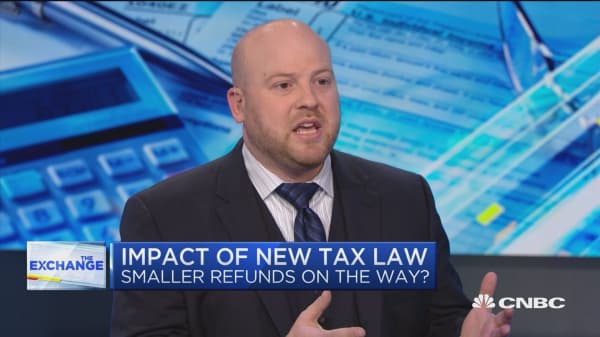
Balancing withholding show chapters Here's how the new tax law could impact tax refunds Here's how the new tax law could impact tax refunds    2:41 PM ET Fri, 8 Feb 2019 | 02:55

If you are an employee, when you were hired your employer gave you a Form W-4, which you can use to tweak the amount of tax that's withheld from your pay.

On that sheet, you can list the number of personal allowances you claim for your household. For instance, you can claim an allowance each for yourself, your spouse and your dependents.

Tread carefully: The more allowances you claim, the less tax you will have withheld.

"We urge people to check their withholding again this year to make sure they are having the right amount of tax withheld for 2019." -Chuck Rettig, IRS Commissioner

If you underpay your taxes during the year, you'll likely owe when you file your return.

"Some people read the form and think, 'I'm married and have three kids,'" said Cari Weston, director of tax practice and ethics at the American Institute of CPAs. "They end up with five allowances and owe substantial taxes at the end of the year."

To make things even more complicated, the IRS has adjusted its withholding tables and Form W-4 to reflect the changes from the Tax Cuts and Jobs Act. The agency has also released a new tax withholding calculator.

Because of the new tax law's increase to the standard deduction and the elimination of personal exemptions, now might be the best time to review your Form W-4 to see if you're withholding the appropriate amount of tax.

Last year's taxes Close-up of IRS Form 1040 FreezeFrameStudio | E+ | Getty Images

If you want to avoid the penalty for underpayment of estimated taxes, aim to pay 100 percent of the prior year's liability, said Jeffrey Levine, CPA and director of financial planning at BluePrint Wealth Alliance in Garden City, New York.

Though this won't guarantee you won't owe the IRS the following spring, it at least means the IRS won't hit you with penalties and interest for coming up short.

"If you see your tax rate increase substantially, you might owe a larger amount over the withholding," said Levine. "Aim for that 100 percent: It's a better method of avoiding the underpayment penalty."

This tax season, the IRS said it would waive the penalty for people who paid at least 85 percent of their total tax liability for 2018.

"We realize there were many changes that affected people last year, and this penalty waiver will help taxpayers who inadvertently didn't have enough tax withheld," said IRS Commissioner Chuck Rettig.

"We urge people to check their withholding again this year to make sure they are having the right amount of tax withheld for 2019," he said.

Here's how to evaluate your withholding and make sure it's just right for you.

Already filed? Look at your 2018 tax return: Whether you received a large refund or you wound up short with the IRS, your 2018 tax return is a guide to how your withholding currently looks under the new tax law.

Use that information to adjust your W-4.

Review your W-4: Striking a balance for withholding will be based on your salary, your spouse's earnings and the tax bracket you're in.

We're in a year with many changes to the withholding table, plus a reduction in federal income tax rates. You may be taking home a slightly larger paycheck, but you should make sure you aren't withholding too few taxes.

Talk to your accountant: Filers who withheld fewer taxes because they itemized on their returns will need to revisit their withholding. That's because the new law does away with a lot of itemized deductions and places a $10,000 cap on state and local tax deductions.

Fewer filers are expected to itemize in 2018 because the new tax law has doubled the standard deduction. Under the previous law, about 49 million taxpayers — roughly 3 in 10 individuals — filed itemized returns, according to the Urban-Brookings Tax Policy Center.

If you fall into that category, you may need to update your allowances in 2018 to ensure you're withholding the right amount of tax.

Calculating your withholding is more complicated if you have multiple sources of income, distributions from retirement accounts or cash from a rental property. You'll need to make estimated quarterly tax payments in those cases, Steffen said.

"Work with a CPA to do a projection and figure out what your tax liability will be at the end of the year," he said. "In a perfect scenario, you'll have a balance due when you file your return, but not one that's large enough to create a penalty."

Avoid tax arbitrage: If you withhold less in taxes because you have bigger plans with your paycheck, bear in mind that you'll owe Uncle Sam next year. Don't gamble your cash.

"Some people do foolish things: 'If I invest the money and make 7 percent this year, and I beat the IRS' penalty, then I'm ahead,'" said Levine. "If you've deliberately underpaid, the money should go someplace safe because this is a really short time horizon," he said.

More from Personal Finance:
Why squirreling away every spare dime in your 401(k) is a bad idea
Don't miss this retirement savings opportunity
The tax law has a bunch of new changes. What you should know

Subscribe to CNBC on YouTube.

Monday, February 11, 2019

90% of America's Workers Want This

Few people would go regularly to a restaurant that offered one item, served one way, with no opportunity for customization. Even someone who really enjoyed that dish would probably tire pretty quickly of it, and the vast majority of the public would either never go or visit only once.

That hasn't stopped companies from taking a one-size-fits-all approach to employees. That's been very evident in the open-office trend. Many businesses have implemented that setup without considering what their employees actually want.

In reality, the best way to retain workers and keep office morale might be to offer employees more choice. Most workers -- a full 90% -- said more flexible work arrangements and schedules will increase morale, according to the 2019 Staples Workplace Survey.

Workers cluster around a computer.

Workers place a high level of value on flexibility. Image source: Getty Images.

What do workers want?

Workers want choice, and they're not in favor of offices that take a one-size-fits-all approach. Specifically, 52% said "an open office layout creates distractions," while 40% said their office is "too open."

Employees aren't necessarily asking for a return to closed offices. Instead, they want more choice -- private rooms for calls and meetings, as well as the ability to work from home when possible. In fact, 64% of workers said they work from home at least some of the time, but only 34% of employers have a formal or informal policy regulating that work. 

That's a situation that could lead to worker discontent if a company tries to tighten up its policy. Two-thirds of survey respondents (67%) said they "would consider leaving their job if their work arrangements became less flexible."

Addressing workplace flexibility requires a company to engage in a dialogue with its employees. It also means thinking about the relationship between work and worker in a different way.

"The concept of work-life balance has given way to the simpler concept of 'work life' -- one's life at work," said Staples Brand Group Vice President Chris DeMeo in a press release. "Employees no longer embrace the traditional 9-to-5 and instead seek an environment that accommodates the fact that their needs may change day to day." 

What can your company do?

Offering flexibility is harder than having a single policy that applies in all situations. You need to craft rules that work for the entire workforce without favoring one person or group over another. That requires a thoughtful discussion -- maybe a lot of them -- and a willingness to constantly re-evaluate.

"The smartest employers are acknowledging this reality and offering their workers more autonomy when it comes to where, when, and how they work," DeMeo said. "It may be a leap of faith for offices used to the old ways of doing things, but it's one that could yield dividends in terms of recruitment, retention, and productivity."

There's no single answer here that applies to every company. Instead, employers need to embrace that what seems right for them may not be what's best for their employees. Finding solutions requires a willingness to give employees a voice and to change policies that may have been in place for a very long time.

Sunday, February 10, 2019

Essent Group Ltd (ESNT) Q4 2018 Earnings Conference Call Transcript

Logo of jester cap with thought bubble.

Image source: The Motley Fool.

Essent Group Ltd  (NYSE:ESNT)Q4 2018 Earnings Conference CallFeb. 08, 2019, 10:00 a.m. ET

Contents: Prepared Remarks Questions and Answers Call Participants Prepared Remarks:

Operator

Good morning. My name is Lindsey, and I will be your conference operator today. At this time, I would like to welcome everyone to the Essent Group Limited Fourth Quarter 2018 Earnings Call. All lines have been placed on mute to prevent any background noise. After the speakers' remarks, there will be a question-and-answer session. (Operator instructions)

Thank you.

Mr.Chris Curran, Senior Vice President of Investor Relations, you may begin your conference.

Christopher G. Curran -- Senior Vice President of Investor Relations

Thank you, Lindsey. Good morning, everyone, and welcome to our call. Joining me today are Mark Casale, Chairman and CEO; and Larry McAlee, Chief Financial Officer. Our press release, which contains Essent's financial results for the fourth quarter and for full-year 2018, was issued earlier today and is available on our website at essentgroup.com in the Investors section. Our press release also includes non-GAAP financial measures that may be discussed during today's call. The complete description of these measures and their reconciliation to GAAP may be found in Exhibit L of our press release.

Prior to getting started, I would like to remind participants that today's discussions are being recorded and will include the use of forward-looking statements. These statements are based on current expectations, estimates, projections and assumptions that are subject to risks and uncertainties which may cause actual results to differ materially. For a discussion of these risks and uncertainties, please review the cautionary language regarding forward-looking statements in today's press release, the risk factors included in our Form 10-K filed with the SEC on February 20, 2018, and any other reports and registration statements filed with the SEC, which are also available on our website.

Now, let me turn the call over to Mark.

Mark Casale -- Chairman, President and Chief Executive Officer

Thanks, Chris. Good morning, everyone, and thank you for joining us. Earlier today, we released our fourth quarter and full-year results, and I'm pleased to report that 2018 was a very successful year for the Essent franchise. During the year, we continue to grow our high credit quality and profitable mortgage insurance portfolio, while also increasing net income and generating strong returns. In addition, we began to take steps to strengthen Essent's business model by increasing our sophistication around risk origination and risk distribution. Key highlights pertaining to this include the successful pilot of our EssentEDGE risk based pricing engine and executing two reinsurance transactions on our 2017 book of business.

Now, let me touch on our results. Our insurance in force grew 25% to $138 billion at year-end, compared to $110 billion at the end of 2017. For the quarter, we earned $129 million or $1.31 per diluted share. On a full-year basis, we earned $467 million, or $4.77 per diluted share. Our results for both periods reflect a $9.9 million, or $0.08 per diluted share reduction in our loan loss provision. This reduction relates to updated expectations on defaults associated with Hurricanes Harvey and Irma that hit the US in 2017. Larry will discuss reserves in more detail in a few minutes.

Our balance sheet remains strong, ending the year with $3.1 billion in assets and $2.4 billion of GAAP equity. Also, we grew adjusted book value per share 24% to $24.29 at year-end 2018 from $19.64 as of December 31, 2017. As a reminder, senior management's long-term incentive compensation is driven by annual growth rates in book value per share. We believe that book value per share growth is a key metric in demonstrating value to our shareholders.

Our outlook for our business remains positive. As we believe, the demographics such as the millennials coming of age and purchasing homes for the first time continue to drive demand and support housings longer-term fundamentals. As a reminder, purchase mortgages are positive for our franchise as the MI penetration rate on these is three to four times that of refi mortgages, with low unemployment rates, affordable 30-year fixed-rate mortgages and builders increasing supply for first-time homebuyers. We remain optimistic heading into 2019.

On the industry front, we continue to see utilization of risk based pricing engines and we recently announced the rollout of our engine EssentEDGE, while EssentEDGE mimics our current pricing, we believe it provides flexibility to increase or decrease rates, allowing us to better shape our portfolio. The engine also provides the capability of pricing more credit attributes at the loan level, unlike the current rate card structure, which is based on broad FICO, LTV and DTI ranges. While not all of our customers are using EssentEDGE, we believe that over time, most lenders will enhance to our front-end processes and technologies to access our engine.

As noted in our press release, we successfully executed an excess of loss transaction with a panel reinsurers during the fourth quarter. The reinsurance is on 2017 NIW and attaches above the existing Radnor Re insurance-linked note transaction completed in March of 2018. The ILN transaction was for $424 million of protection on approximately $10 billion of risk and the XOL transaction adds a $165 million layer on top of the ILN. On a combined basis, as of year-end 2018, the ILN and XOL provide $589 million of protection on top of a $225 million first loss layer that we retain. We are very pleased to have completed these transactions and plan on executing additional reinsurance transactions going forward. From Essent's beginning, we have taken a long-term approach to ensuring and managing mortgage credit risk. Given the cyclical and long tail nature of the MI business, we recognize the limitation of a buy-and-hold approach. Accordingly, we continue to evolve into a more sophisticated risk manager by distributing risk and diversifying our sources of capital. This allows us to hedge against adverse stress scenarios and mitigate housing cycle volatility, while making Essent stronger and more stable counter-party.

In addition, distributing risk to the capital markets and reinsurers is not only a hedge to our cycle dependent franchise, but it can also be accretive to returns by freeing up capital at a lower cost without adding financial leverage to the balance sheet. We believe that this strategy along with future earnings should generate excess capital going forward. Our objective and best deploying excess capital will be to strike the balance between return objectives and strong capital levels, while also giving consideration to what is in the best long-term interest of our franchise, policyholders and shareholders.

On the Washington front, we continue to believe that Essent and our industry are well positioned to support a well functioning and robust housing finance system. We also believe that this position will strengthen as we execute upon our buy, manage and distribute strategy. We look forward to working closely with new FHFA leadership, and we will continue to support USMI and engage with policymakers and promoting the benefits of private mortgage insurance and our strengthening business model.

Now, let me turn the call over to Larry.

Lawrence E. McAlee -- Senior Vice President and Chief Financial Officer

Thanks, Mark. Good morning, everyone. I will now discuss our results for the quarter in more detail. Earned premium for the fourth quarter was $173 million, an increase of 4% over the third quarter of $167 million, and an increase of 17% from $148 million in the fourth quarter of 2017. Net premium ceded on our reinsurance transactions are reflected as a reduction of earned premium and were $3.7 million in the fourth quarter and $3.2 million in the third quarter of 2018.

The increase in premium ceded in the fourth quarter is due to the placement of our excess of loss reinsurance coverage, which was effective November 1st. We had no reinsurance in place or premiums ceded in 2017. The average net premium rate for the fourth quarter was 49 basis points, which was one basis point lower than the third quarter of 2018 due to the increase in premium ceded under the XOL transaction, a lower level of single cancellation income and the impact of lower BPMI pricing implemented in 2018. We expect our average net premium rate to decrease to approximately 47 basis points by the fourth quarter of 2019. This reduction in the premium rate is anticipated to be driven by the BPMI pricing changes enacted in 2018, and an increase in premiums ceded based on our expectation that we will increase the percentage of our insurance portfolio that is covered by reinsurance.

Investment income excluding realized gains was $19 million in the fourth quarter of 2018, compared to $17 million in the third quarter and $12 million in the fourth quarter a year ago. The increase in investment income of 12% over the third quarter of 2018 and 58% over the fourth quarter of 2017 is due to an increase in the balance of our investments as well as an increase in the yield under our portfolio. The yield increased from 2.2% in the fourth quarter of 2017 to 2.8% in the fourth quarter of 2018, primarily as a result of the impact of the increase in market interest rates for new assets purchased and an increase in the average duration of the portfolio. We remain pleased with the credit performance of our in-force book.

Our provision for losses and loss adjustment expenses was a benefit of $1 million in the fourth quarter of 2018, compared to a provision of $5.5 million in the third quarter and $17.5 million in the fourth quarter a year ago. The provision in the fourth quarters of 2018 and 2017 were both impacted by Hurricanes Harvey and Irma. In the fourth quarter of 2017, we recorded a reserve of $11.1 million associated with the increase of 2,288 defaults in the areas impacted by the hurricanes. Based on favorable cure activity and our expectation of the ultimate losses to be paid, the provision for losses and loss adjustment expense in the fourth quarter of 2018 includes the release of $9.9 million of the reserve previously recorded in 2017. The default rate on the entire portfolio increased 5 basis points from September 30, 2018 to 66 basis points at December 31st.

Other underwriting and operating expenses were $39.4 million for the fourth quarter of 2018, compared to $36.9 million in the third quarter and $36.5 million in the fourth quarter a year ago. We continue to leverage our platform as evidenced by the reduction in our expense ratio from 27.5% in 2017 to 23.2% in 2018. For the full-year 2019, we estimate that other underwriting and operating expenses to be in the range of $160 million to $165 million.

Our estimated annual effective tax rate as of the end of the third quarter was 16.2%. As of year-end, our final effective tax rate for 2018 was 16%. As a result, our effective tax rate for the fourth quarter was 15.5%. We estimate that our effective tax rate for 2019 will be in the range of 16% to 16.5%.

The consolidated balance of cash and investments at December 31, 2018 was $2.9 billion. The cash and investment balance at the holding company was $78 million. No capital contributions or dividends between the holding company and operating businesses were completed during the most recent quarter. At year-end 2018, we have $275 million of undrawn capacity under the revolving component of our credit facility and $225 million of term debt outstanding.

As of December 31, 2018, the combined US mortgage insurance business statutory capital was $1.9 billion, with the risk-to-capital ratio of 13.9 to 1 compared to 14.1 to 1 at the end of the third quarter. The risk-to-capital ratio at year-end 2018 reflects a reduction in risk in force of $589 million for the reinsurance coverage obtained from our insurance-linked note and excessive loss transactions. At the end of the fourth quarter, Essent Re had GAAP equity of $799 million, supporting $8.3 billion of net risk in force. In addition, Essent Guaranty's available assets exceeded its minimum required assets as completed under PMIERs by $362 million.

Now, let me turn the call back over to Mark.

Mark Casale -- Chairman, President and Chief Executive Officer

Thanks, Larry. In closing, Essent generated another strong quarter of financial results as we continue building a high credit quality and profitable mortgage insurance portfolio. The operating environment during the quarter was favorable and we remain pleased with the credit performance and our market presence. Looking forward, our outlook on our business remains positive and we believe that increased utilization of risk-based pricing and reinsurance will make Essent a stronger company.

Now, let's get to your questions. Operator?

Questions and Answers:

Operator

(Operator Instructions) Our first question comes from the line of Mark DeVries with Barclays. Your line is now open.

Mark DeVries -- Barclays -- Analyst

Thanks. I was just hoping to get your updated thoughts on your abilities/interest in returning capital here?

Mark Casale -- Chairman, President and Chief Executive Officer

Yeah, Mark, I think -- I think, as we look at the end of the quarter or the end of the year, we feel like the excess that we have PMIERs 360 million, we have HoldCo cash, we have a little excess at Essent Re. We're probably in the strongest capital position that we've been in since we started the company. That being said, a lot of that excess is being driven by the insurance-linked note transaction that we did earlier this year -- earlier last year, and it really only covers 30% of our insurance in force.

So once we complete a deal on the 2018 book, which we would expect to do in 2019. I think, we'll have more visibility in the kind of sustainability of that excess, Mark. So once we do that and I think we'll look at all factors. So, first and foremost, we would look to reinvest it in the business and I'll remind you that we grew insurance in force 25% year-over-year. So there is still opportunities to be deployed in the business in the States. Bermuda continues to grow and we really like -- we really like some of the opportunities in Bermuda, like we said, it's another platform for us to grow and take on US mortgage risk, so there's opportunities there. And there is potentially opportunities outside the company. That being said, we will look to and we'll evaluate capital distribution.

I think, we've been pretty thoughtful life to date in terms of how we -- how efficient we have been around the use of capital both equity and debt. We're going to -- we'll apply that same thought on us to capital distribution. So, I would stay tuned, but it's something that's on our radar screen and we'll be able to update you more in May, assuming we can get a deal done in the first half of the year. Once we get that deal done around the reinsurance, I think we'll be able to give you more visibility around that question.

Mark DeVries -- Barclays -- Analyst

Okay. And given how attractively priced the reinsurance is that you can get through the ILN market, do you think it'll make sense to insure up to 100% of your risk?

Mark Casale -- Chairman, President and Chief Executive Officer

I think at some point, that's the plan, Mark. I think that's the plan. I think we're more concerned, obviously, with future books, the past books are relatively pretty strong, right, especially from a mark-to-market LTV standpoint, but if you look and say, 2017-'18 and say the 2019 book, that's going to be 80% of the insurance in force by the end of this year. So we're more focused on the newer production, but the plan over time and again, we've said this before, we would look to -- at the end of each year reinsure that book. So over the course of the next few years, we would expect to have 100% of the book reinsured.

Mark DeVries -- Barclays -- Analyst

Okay, got it. Thank you.

Operator

Our next question comes from the line of Bose George with KBW. Your line is now open.

Bose George -- KBW -- Analyst

Hi, guys. Good morning. So just following up on that question on capital. I mean, it looks like you guys have a deal in the market in ILN transaction. So I mean to the extent that happens, I mean, could we hear something on capital sooner? Or do you still think there could be -- it's something that you have to assess and maybe a little later in the year?

Mark Casale -- Chairman, President and Chief Executive Officer

Well, again, we can't really comment on the deal. And I think once -- again, our plan is to reinsure the '18 book, during the first half of 2019 and once that deal gets done, I think we'll have more visibility that we'll be able to share. I'm not saying there is any answers to be sure, but I do think we are evolving as we continue to generate excess capital. We're going to look for opportunities to put that to work again in the business or in a potentially distributed shareholder. So we'll be thoughtful about it. I wouldn't -- I think, once we have that deal, if we are able to complete that transaction, we would be 50% of the book, a little bit over 50% of the book will be insured. So we'll have more visibility. But again, we're going to be thoughtful about it. And I think we've been good stewards of capital. So I think that's the real message for investors to take away. As we're going to be really thoughtful about this and we're going to do what's in the best interest of shareholders. There's no doubt about that. There's just no rush to do it and give answers. I know every quarter folks want to hear answers. But I would say we feel like we're in a good capital position, and remember, capital begets opportunities. We just want to make sure that we get -- we feel better around the insurability of the portfolio and able to execute those transactions and once we do, we'll send a pretty clear signal to the market.

Bose George -- KBW -- Analyst

Okay. It make sense. Thanks. And then, if you -- just on the XOL transaction that you guys did, can you just talk about, is there an incremental capital benefit to adding the XOL on top of the ILN?

Mark Casale -- Chairman, President and Chief Executive Officer

Yeah, it's a good question. I mean, it does add incremental capital release both from an economic capital and we believe from a rating agency. There is no PMIERs credit for that. So our thought with the XOL was we wanted to tap into an additional source of capital, which is the reinsurance -- the reinsurers which we hadn't done to date. We also wanted to test higher up in the structure. So we feel we're pretty well covered now from say 2.25 to closer to kind of 9 plus percent. So that's -- we feel in terms of people have asked us, what does that mean in a stress scenario? It's a pretty good result, so base case is our 2% to 3% claim rate. If we were to hit a mild recession, mild plus maybe with a 5% claim rate, our returns would still be in the mid-teens, right, because we wouldn't 5% claim rate, which we've hit into the reinsurance.

If we were to take that 2017 book and put it through the great recession, we think the claim rate would be right around say 12% (ph), which is a little lower than the great recession, but keep in mind, it's a better -- it's a better credit quality book. That's the case we're probably still low single-digit return set, that's a pretty strong statement, and I think that's the real takeaway with reinsurance is it's removing not only the volatility from some of our earnings, but removing the volatility from the balance sheet. And I think that's the key. So when we talk about rapid and then the capital distribution. We want to make sure that stuff is set first before we -- the worst scenario would be. We do -- we start to talk about capital distribution and we haven't protected the balance sheet. And that's our number one goal. And our credit -- credit kills these businesses and we will go and not sure when we'll go into the next recession, but I'd much rather go into recession knowing that we have -- we have protection on the book

Bose George -- KBW -- Analyst

Okay. Make sense. And then, actually, just the run rate cost on the XOL, that's about 1.5 million a quarter, is that right?

Mark Casale -- Chairman, President and Chief Executive Officer

No, not only XOL, I would say, I would look at all in. Those are simpler way to look at it is probably approximately 5 basis points on the cost of those transactions. So if you think about that, that will work its way into the portfolio over time, it clearly impacted some of that in 2018. But I think that's a simpler way for you guys to think about it.

Bose George -- KBW -- Analyst

Okay. And the 48 basis point guidance that you gave us for the year the net number, it incorporates the cost of this transaction as well as the sort of the lower -- lower NIW premiums upcoming, right?

Lawrence E. McAlee -- Senior Vice President and Chief Financial Officer

Yes, it is. It's a combination of the pricing change that its way -- halfway through the year and the reinsurance. I think the number was 47 that we gave in terms of the guidance, so 49 in 2018 trending down to 47 by the end of this year.

Mark Casale -- Chairman, President and Chief Executive Officer

Correct.

Bose George -- KBW -- Analyst

Okay, great. Thanks.

Operator

Our next question comes from the line of Rick Shane with J.P. Morgan. Your line is now open. Rick Shane with J.P. Morgan. Your line is now open.

Rick Shane -- J.P. Morgan -- Analyst

Mark, can you hear me?

Mark Casale -- Chairman, President and Chief Executive Officer

Yes, I can Rick. You haven't called in a while, so it's hard to recognize your voice.

Rick Shane -- J.P. Morgan -- Analyst

Oh, jeez. Hey, I apologize, I got dropped off the line for a second. So if I got queued up and got kicked out, I apologize.

Mark Casale -- Chairman, President and Chief Executive Officer

No, worries.

Rick Shane -- J.P. Morgan -- Analyst

Look, I heard the questions about return of capital and realized that there is -- there are some events that needs to occur before you approach that but love to talk philosophically about how you think about the difference between dividend and repurchase. Obviously, repurchase is accretive to earnings with the stock trading at a premium to book, it does dilute book value a bit. Just want to see how you think about that going forward?

Mark Casale -- Chairman, President and Chief Executive Officer

Yeah, it's something -- I think we're going to look at those very carefully and I don't think we have a good answer for you today. I do think dividends is a strong demonstration of kind of the cash flow generation of the businesses and I think it will become more readily apparent as we move forward and continue to generate excess capital. I think in terms of repurchase, I think it's more opportunistic. I don't think you want to get on into a program where you're increasingly buyback shares at an increasingly high share price, that's a dangerous.

I think we -- we lose capital flexibility there. And again, these are balance sheet businesses, strong capital begets opportunities and you don't want to get into that type of game. I don't think that's in the best interest for shareholders' long-term. And short-term, I think, some folks may like it. But again, we're building this business for the long-term. And remember, we're all -- the senior management teams are shareholders. So we're pretty focused on providing shareholder value in addition to building a really good business. So again, it's something where we'll be thoughtful about. And just like we did when we raised equity and we raised -- we build our line of credit. Some of it's going to depend on market conditions and it's something that's -- that will be under evaluation is under evaluation now and obviously it's going to be an increasingly bigger part of the Essent story going forward.

Rick Shane -- J.P. Morgan -- Analyst

Got it. Yeah. Look, I think, ultimately, these are high-quality questions you get to ask yourself.

Mark Casale -- Chairman, President and Chief Executive Officer

Yes, it's a good problem to have, to be honest.

Rick Shane -- J.P. Morgan -- Analyst

Thank you very much, guys.

Mark Casale -- Chairman, President and Chief Executive Officer

You're welcome.

Operator

Our next question comes from the line of Doug Harter with Credit Suisse. Your line is now open.

Douglas Harter -- Credit Suisse -- Analyst

Thanks. Can you talk about your outlook for expenses and how much lower you think the expense ratio can (inaudible)?

Mark Casale -- Chairman, President and Chief Executive Officer

Yes, sure. I mean, again, we're much more focused, Doug, on the nominal expenses, so we gave the guidance of 165 million. In terms of expense ratio, I think it's going to be the math, and don't forget, we're in an environment where the premiums are coming down, right. We have those -- the premium -- the compression in premium that hit last year with the rate card change, which for all intents and purposes was mitigated by the reduction in taxes. So the returns were similar. And then we're obviously ceding premium for the reinsurance, which we think is a great trade off. This is going to impact on the expense ratio. So the old story of premiums being, as they continue to grow and expenses continuing to go down, it's going to be a little bit different. So I don't know if it's going to be as important of a gauge. I still think we're still in that 35 to 40 kind of guidance when you put it all together. However, I don't -- I wouldn't expect a continual decline as you may have in the past. I mean there is a little bit of moving around of some of the factors. The important takeaway those returns are still strong. And I think that's the one. I wouldn't get too caught up in the ratios, but I think the big ratio is where -- what's the return on equity and we still feel like that's firmly in the mid-teens

Douglas Harter -- Credit Suisse -- Analyst

Got it. Thanks, Mark.

Mark Casale -- Chairman, President and Chief Executive Officer

Sure.

Operator

Our next question comes from the line of Phil Stefano with Deutsche Bank. Your line is now open.

Phil Stefano -- Deutsche Bank -- Analyst

Yeah, thanks. So, Mark, as we think about the building of capital and the opportunities coming out of Bermuda, I feel like it's been a while since we've talked about the internal quota share. Are there any updated thoughts around that? Is 25% still the right number? And now that you've had a chance to digest the tax reform, I was hoping to revisit that?

Mark Casale -- Chairman, President and Chief Executive Officer

Yeah, I mean, I think we're still in the camp of the 25%, Phil. Remember, we're still subject or could be in around the V Tax in the calculation. We feel like with the 25% quota share, we are -- we have a nice margin of safety with that. And there's really no -- there's no really -- there is no desire or intent to kind of grow that. So, very good question. I think that the real story around Bermuda is to continue growth in the third-party business and again it's relatively small compared to our US business. But that's not to take away from how well it's done and we've done well over 50 GSE risk share deals. We started to build out the MGA and starting to help larger reinsurance companies to avoid capital. It's a real platform for us to take on that risk and some nice optionality in terms of the market. So if the market were to soften, you know, I think there could be more opportunity to write business there in -- in Bermuda, you know, it could be some impact on the reinsurance, but those things are always linked. So either we like, kind of the optionality that our Bermuda platform works.

Phil Stefano -- Deutsche Bank -- Analyst

Got it. And Mark, earlier and I can't remember if it was you're prepared remarks or response to a question. You said something about additional reinsurance transactions, and maybe I'm parsing the words too much, but is it -- is this going higher in the tower with additional XOL? Or is this just putting ILNs and XOL on additional vintages as we look forward?

Mark Casale -- Chairman, President and Chief Executive Officer

Yeah, it's more toward additional vintages where -- yeah, I think we're done on the 2017 book and it's -- we're focused now is to reinsure the 2018 book.

Phil Stefano -- Deutsche Bank -- Analyst

Got it. Okay. One more quick one on EssentEdge and I've asked some of your competitors and nobody wants to venture a number on this, but I -- I'm going to keep banging. How many pricing inputs and metrics are you guys currently utilizing in the -- you know, is there right number that you think about being the tipping point of getting pricing, you know, quote unquote, right?

Mark Casale -- Chairman, President and Chief Executive Officer

That's a great question. We'll be pretty upfront. We use approximately 12 to 15 factors around the model. And it's the same factors we've used historically filled to assess losses and to assess our economic capital. We just never really had the ability to pass that on the pricing because remember, up until last June, the records were only comprised of two factors and then after June and went all the way up to four factors. So we never really had the ability to kind of be more granular on the pricing. So, we think the 12 to 15 -- and it can't really get into the factors, but we do think it's more meaningful to allow us to deliver more granular pricing, initially that will mimic the rate card pricing more or less at least there'll be some, you know, as more granular option. So at some places where it'll be higher, some places it will be lower, but the goal right now is to keep it right around, very similar pricing.

The important point around the Edge and this gets lost is the flexibility that it provides to both increase or decrease pricing. It just didn't have that flexibility of the rate card, you have to go to 50 states, you have to refile and you also have very difficult decisions with lenders. I and -- we've been doing this now for close to 10 years at Essent and I've always found when we lower rate cards to lenders, it's very well received. That's never not well received. It doesn't really go that way the other side. And I think as you go into a potential slowdown and the -- and the, you know, the industry experience is back and away. It's very difficult to pass on price increases. And I think now with the flexibility of the engine and the fact that we're pricing each borrower separately, should we see a slowdown or here's a good example of how it's linked to the reinsurance. If we go and reinsure parts of future books and that cost is higher. Well, that's the markets telling us something around credit that maybe we're not aware of and now we're -- now we have a mechanism to link that back to the front end in a more granular basis. So we don't have to have a hard discussion with the lender, which is very difficult when you're among six competitors. So there's a little bit of gamesmanship there at a lender level that is -- that it's very hard to get across, but if through the engine you may decide there's certain regions you don't like or there's a certain pocket of LTVs or DTIs or whatever FICO ranges that you're not as comfortable with, given where you think HPA is going in this region. You now have the ability to -- to adjust pricing and -- and I think that is -- that's what's the -- that's the real big picture. I think when we talk about getting more sophisticated around risk origination that's what we mean with EssentEdge. This is a risk tool. It's not a market share tool. It's not a pricing tool.

Originally when -- when the engines hit the market back in 2010 and '11 when UGI first had it, it was a way to pass on lower price. And that -- that was the way to do. It is priced well below the card. That's not the case anymore. I think you're going to find engines that have higher prices in certain pockets and other ones have lower. Each MI I think eventually will have their own kind of credit appetite and -- and as you think going forward, so it's going to be credit. Credit selection is going to be a key differentiator in terms of the MI business. That's never really been the case before. It's all been the same rates, the same underwriting guidelines. And I think that -- I think we're relatively well equipped to be in this new world and how you work that into new factors and all so forth is we'll be seeing how successful some guys can be. But I think the flexibility of it is -- is really the important takeaway.

Phil Stefano -- Deutsche Bank -- Analyst

Well, thank you, Mark. Your candor around the Edge and recessionary returns is refreshing and I hope that some of your peers are also so forthcoming with the information and we appreciate it.

Mark Casale -- Chairman, President and Chief Executive Officer

You're welcome.

Phil Stefano -- Deutsche Bank -- Analyst

See you all guys.

Operator

Our next question comes from the line of Mackenzie Aron with Zelman & Associates. Your line is now open.

Mackenzie Aron -- Zelman & Associates -- Analyst

Thanks. Good morning. I guess just kind of the last question from me. It's just related to your outlook as you look into 2019 on volume, what the opportunity could be this year given what we're seeing on the origination. And then secondly with rates doing what they've done year-to-date can persistently continue to improve, I mean, just what should we be expecting for the year on those two metrics?

Mark Casale -- Chairman, President and Chief Executive Officer

Sure. So ball's well with you. We are -- in terms of persistency, I think the guidance this year is still in the low 80s, I mean, we -- we're tick higher than that in 2018, but I think that's a -- that's good guidance. Longer-term, it's hard for us to give guidance, you know, anything above 80. I always think 80% is good long-term guidance. In terms of NIW, you know, clearly I think the market was impacted in the fourth quarter. It was a pretty sudden rise in rates, Mackenzie, and I think it took a while for consumers to adjust to that, which I think is natural and then you historically go into the fourth quarter slow down. I think our view on 2019 NIW right now -- I think -- I think it -- you know, we believe it's still -- it will be similar to 2018. I think once we see where the spring season goes that -- that'll give us some more visibility into that, but right now we're not seeing much to say it's going to be different.

And remember we're -- we are -- we're levered to the first time homebuyer and as you guys know, you cover builders, the builders are still -- in fact, a lot of builders are increasing their supply around the first time homeowner. So, our average loan size is 230,000. And when you look at some of these -- these newer homes that are in that, you know, $200,000 to $225,000 range, so it's -- I think we're actually well positioned from that. And we've always said, we believe because of the demographics that housing will be bigger and they'll continue to grow. We never said it would be in a straight line. So there's always going to be fits and stops and -- and those stops could be quarters, they could be a year. But longer term, we still think the fundamentals around housing and the ability for it to continue to grow are still in place. So I think that's why we say, we remain optimistic for 2019, but I guess we'll -- we'll see when the spring season hits.

Mackenzie Aron -- Zelman & Associates -- Analyst

Okay, good to hear. And we certainly agree with that. Just one -- one quick one on the modeling. Does the tax guidance, does that include the expected tax benefit from stock comps in the first quarter?

Lawrence E. McAlee -- Senior Vice President and Chief Financial Officer

No. And Mackenzie, this is Larry. That's really a good -- great question. That's a discrete event that we would recognize in the first quarter. We expect that to be relatively moderate this year. Last year was a little bit larger because of the vesting of certain shares in the first quarter of the year. But we would estimate the impact of that to be between $0.01 and $0.02 per share in the first quarter.

Mackenzie Aron -- Zelman & Associates -- Analyst

Okay, good. Good to know. Thank you.

Operator

Our next question comes from the line of Jack Micenko with SIG. Your line is now open.

Jack Micenko -- SIG -- Analyst

Hi, good morning. Mark, when you talked about EssentEdge a couple times, both in prepared and Q&A. You mentioned the word mimic. And I'm curious -- I think you're still on pilot. So does mimic mean you're just sort of running it and testing it and seeing what adoption looks like? Or was that meant to say, hey, we're not letting our customers arb us on price in our engine versus the rate card and maybe that has broader implications for what may be the market, what's happening in the marketplace? Just curious.

Mark Casale -- Chairman, President and Chief Executive Officer

Maybe yes, to all -- all the above. We're certainly desk testing and we're very -- we focused last year with the pilot -- very focused on on adoption by lenders and getting the ease of use. Yeah, we don't really want to turn it into an arb. So -- and, you know, so it's -- it's very similar to the overall I would say premium rate, I think that's the thing to focus on Jack. We're targeting -- we're targeting earn premium rate. So certain pockets may be lower sales meaning, some may be higher. But there shouldn't be much difference from a lender perspective around the card versus the engine at this point in our life cycle.

And we felt when the rate cards changed last year in June, with the addition of DTI and the multiple borrowers, we felt like that. That captured a lot of, you know, kind of the inherent risks that were the differences between the cards and the engines. And it's given us a lot of time now, so we can get the engine out there, get it adopted, get lenders using it and again longer term it's -- the more the lenders use it the more you have that flexibility that I spoke about earlier. So again it's -- there's an operational component to this and you know, that -- that we're -- that we're very well aware of and the lender market didn't change overnight. I mean, lenders still have to close loans, you know, and -- and so under -- our underwriting and how well we do that is still part of the business. So the Edge is really just another tool of which we can help lenders grow their businesses, so we're not really in it to gain share with it or change pricing that drastically. We'll continue to test and look at additional factors. So we would -- we would expect the engine to evolve over time. It's kind of like a journey and you think about the credit card business evolved over time too in terms of how it used different factors. So I think it's very, very early in its life cycle. But as I said, you know, earlier longer term, I do think it shifts some of the pricing power from the lenders to the MIs and I think that's -- it's at subtle point, but it's going to be a real valuable point especially in times of stress.

Jack Micenko -- SIG -- Analyst

Okay, yeah. And then you also said as part of the capital conversation earlier in the Q&A, opportunities outside of us and can you elaborate more on how you're thinking about, you know what that means?

Mark Casale -- Chairman, President and Chief Executive Officer

Yeah, it's -- it's, you know, we always look at things outside of us. And I think that's, you know, we're in the capital allocation business, I wouldn't pay that much mind to it to be honest, unless a really good opportunity came up. We're really focused on the two existing businesses. I think that's our -- that's the best place to deploy capital and we're not going to deploy capital outside Essent just for the sake of doing it. We would certainly rather distribute it to shareholders versus do it just to diversify. That's -- we're very focused on return so it's -- this is, you know, we built the business on being focused, so really focused on the two core businesses. It's an opportunity for big fat pitch came down the middle of the plate Jack, you know, we're going to do it, but, you know, we're -- that's something you know, they happen -- they don't happen very frequently. So we're more focused on the business that we have and I think capital distribution like I said earlier something that's really under care -- careful evaluation.

Jack Micenko -- SIG -- Analyst

Okay, thanks for that clarification.

Operator

Our next question comes from Mihir Bhatia with Bank of America. Your line is now open.

Mihir Bhatia -- Bank of America Merrill Lynch -- Analyst

Hi, thank you for taking my questions. Just starting real quick, I had a question on your LTV, the 95-plus LTV seems to have stabilized in the last few quarter around 17%, is that a good number going forward?

Mark Casale -- Chairman, President and Chief Executive Officer

Yeah, I think it is. I mean, it's really being driven by -- by the GSEs and there's two takeaways there. One, the coverage is less than our 95. So, the coverage is only 25%. So there's actually, you know, there's a risk mitigant there. The other the other mitigant is -- at least makes me feel good as the -- the FICOs are still at relatively high levels, not quite where the overall portfolio is, but relatively high levels and the performance has been pretty good. So unless since the GSEs are really driving that, unless we were at a price up for it, which I know, you know, we have the capability within the engine now to do -- we may look to do it, but right now, I think we feel pretty comfortable -- we feel pretty comfortable with that limit. And, but again, as the Edge gets rolled down to the market there, we may -- we may look to shape that if we see something in originations that we don't like, but right now, we've been pretty comfortable with it.

Mihir Bhatia -- Bank of America Merrill Lynch -- Analyst

Great, thank you. And then just I guess, similar topic of it, how much -- can you comment maybe on the status to non-GSE market? Is that something that you're all seeing a little bit more growth in, is that a market you all are participating in? Or is it still mostly -- it is mostly all GSE, but I'm just curious on how non-agency is evolving as rates go up and maybe there's a little more pressure from the originators to do something -- (multiple speakers)

Unidentified Speaker --

Yeah, it's a good question. I actually break it into two parts, you know the -- 5% of our business is non-GSE. But that is 100% bank balance sheet and that's mainly jumbos or professional loan programs. And that's -- that has gone. I think we're very pleased with that business, depending on what goes out GSE reform, you know, could that shift a little bit more loans to the bank balance sheet? Again, I think we're relatively well equipped there. In terms of non-QM, clearly a lot of chatter in the market around non-QM, I still think it's relatively small compared to the size of the mortgage market. For all intents and purposes, it's -- it's almost FHA fall out. So this is a borrower now that probably can't get an FHA loan certainly can't get a conventional loan and they're looking kind of at the non-QM market that's not -- again, I think for, you know, advice we give to lenders is it's really about efficiencies and leveraging their cost structure. Once -- once you get into some of those products, it's very difficult, it does soak up some capacity, but it's probably not the best way, I think from a risk stand -- for the lender meaning. And I think from a risk standpoint, it's not something we really have -- we really focused on. And again it's just such a good conventional business out there and the bank balance sheet, like we said, we're very pleased with our market presence, we don't feel the need to stretch. And you can even see that in our FICOs, I mean very limited -- very limited kind of percentage of our portfolio is below 680 (ph). I think the non-QM for us is not something we're really on our radar screen.

Mihir Bhatia -- Bank of America Merrill Lynch -- Analyst

Great. Thank you. Thanks for taking my questions.

Operator

Our next question comes from Bose George with KBW. Your line is now open.

Bose George -- KBW -- Analyst

Hey guys, thanks. Just had a quick follow-up on the comments you made on the tax rate. So is it -- annual tax rate still end up being around 15%, so the first quarter is $0.01 or $0.02 impacts of that something like 14 and then the others are slightly higher is that how it's going to look?

Mark Casale -- Chairman, President and Chief Executive Officer

No, just I'll clarify. So the annual effective tax rate, excluding discrete items, we expect to be in the 16% to 16.5% range. In the first quarter, we'll have a discrete tax accounting benefits associated with the shares of our plan to invest in the first quarter and the excess benefit on that we expect to be $0.01 to $0.02 per share. So in the first quarter we'll have a rate in income tax expense of between 16% to 16.5% of pre-tax income plus or that will be reduced by a benefit of about $0.01 to $0.02 per share. For the remaining three quarters, we expect to -- our rate to be 16% to 16.5%. Does that answer the question?

Lawrence E. McAlee -- Senior Vice President and Chief Financial Officer

On a blended rate though, it would be a little lower.

Bose George -- KBW -- Analyst

Yeah, that makes sense. Yes. Great. Thank you.

Mark Casale -- Chairman, President and Chief Executive Officer

Sure.

Operator

There are no further questions in queue at this time. I will turn the call back over to management for closing comments.

Mark Casale -- Chairman, President and Chief Executive Officer

Okay. Thank you, operator. Before ending our call, we'd like to thank everyone for participating today and enjoy your weekend.

Operator

This concludes today's conference call. You may now disconnect.

Duration: 42 minutes

Call participants:

Christopher G. Curran -- Senior Vice President of Investor Relations

Mark Casale -- Chairman, President and Chief Executive Officer

Lawrence E. McAlee -- Senior Vice President and Chief Financial Officer

Mark DeVries -- Barclays -- Analyst

Bose George -- KBW -- Analyst

Rick Shane -- J.P. Morgan -- Analyst

Douglas Harter -- Credit Suisse -- Analyst

Phil Stefano -- Deutsche Bank -- Analyst

Mackenzie Aron -- Zelman & Associates -- Analyst

Jack Micenko -- SIG -- Analyst

Mihir Bhatia -- Bank of America Merrill Lynch -- Analyst

Unidentified Speaker --

More ESNT analysis

Transcript powered by AlphaStreet

This article is a transcript of this conference call produced for The Motley Fool. While we strive for our Foolish Best, there may be errors, omissions, or inaccuracies in this transcript. As with all our articles, The Motley Fool does not assume any responsibility for your use of this content, and we strongly encourage you to do your own research, including listening to the call yourself and reading the company's SEC filings. Please see our Terms and Conditions for additional details, including our Obligatory Capitalized Disclaimers of Liability.